
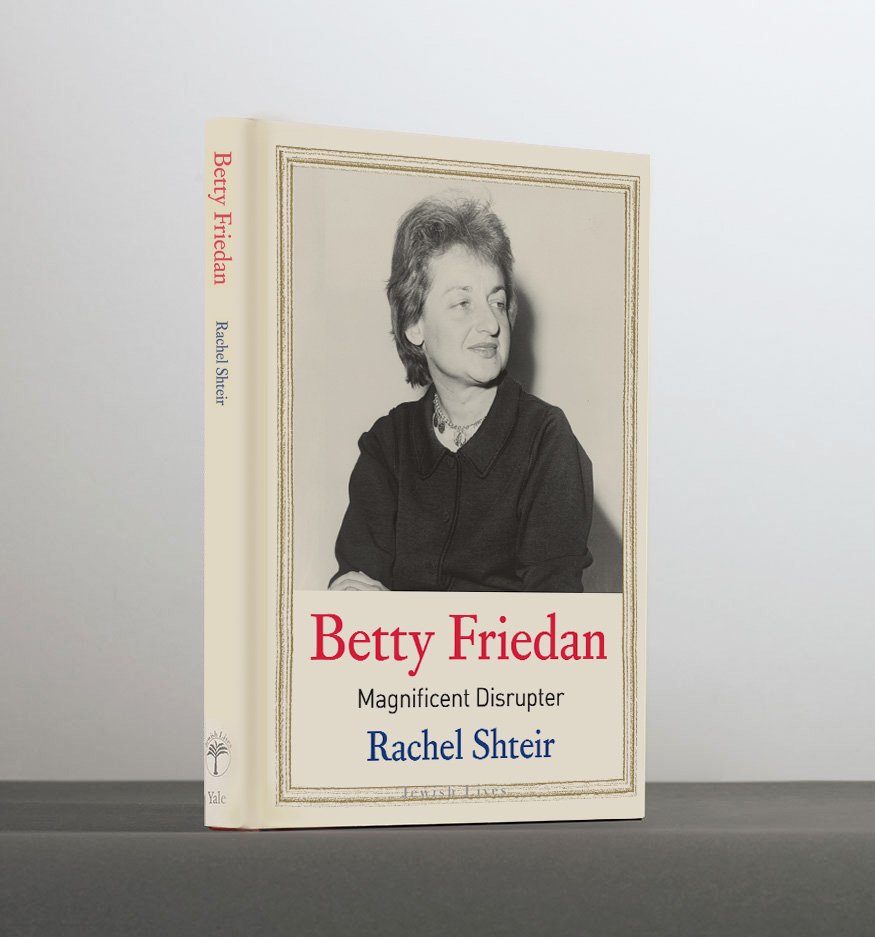
Join Jewish Lives and Park Avenue Synagogue for a FREE in-person or online discussion with author Rachel Shteir about the life and legacy of Betty Friedan.
Betty Friedan, author, activist, and champion for women’s rights, was both a powerful and polarizing figure. As a journalist covering racism, sexism and antisemitism, and later as the author of the groundbreaking work The Feminine Mystique and cofounder of the National Organization of Women (NOW), Friedan fought for important protections for women. Author Rachel Shteir will share how Friedan’s Judaism was essential to her feminism, and how her work leaves a lasting legacy.
Rachel Shteir is an award-winning essayist, writer, and critic, and is head of the Dramaturgy and Dramatic Criticism Program at the Theatre School at DePaul University. She is the author of Striptease: The Untold History of the Girlie Show, Gypsy: The Art of the Tease, and The Steal: A Cultural History of Shoplifting.
This program is in partnership with Park Avenue Synagogue.
Save 25% on Betty Friedan: Magnificent Disrupter. Use code FRIEDAN at checkout.

By Rachel Shteir
Published September 12, 2023
384 pages
“A lucid portrait” —Publishers Weekly
A new portrait of Betty Friedan, the author and activist acclaimed as the mother of second-wave feminism
The feminist writer and activist Betty Friedan (1921–2006), pathbreaking author of The Feminine Mystique, was powerful and polarizing. In this biography, the first in more than twenty years, Rachel Shteir draws on Friedan’s papers and on interviews with family, colleagues, and friends to create a nuanced portrait.
Friedan, born Bettye Naomi Goldstein, chafed at society’s restrictions from a young age. As a journalist she covered racism, sexism, labor, class inequality, and anti-Semitism. As a wife and mother, she struggled to balance her work and homemaking. Her malaise as a housewife and her research into the feelings of other women resulted in The Feminine Mystique (1963), which made her a celebrity.
Using her influence, Friedan cofounded the National Organization for Women, the National Women’s Political Caucus, and the National Association to Repeal Abortion Laws. She fought for the Equal Rights Amendment, universal childcare, and workplace protections for mothers, but she disagreed with the women’s liberation movement over “sexual politics.” Her volatility and public conflicts fractured key relationships.
